|
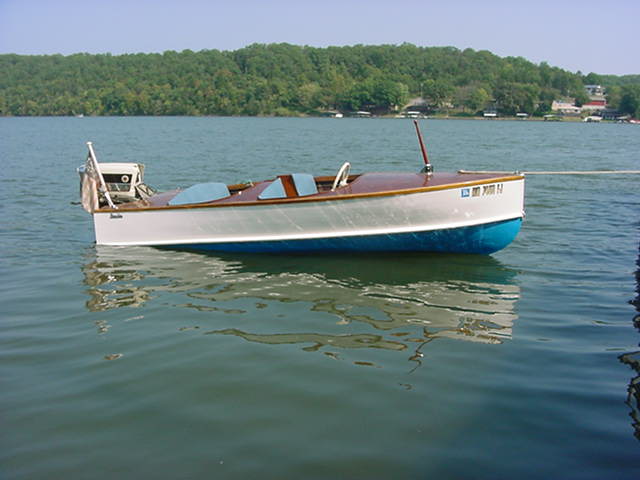
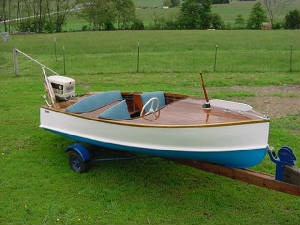
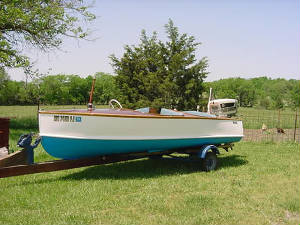
This is a very rare 1954 Penn Yan Captivator in very good original condition has been sold and is moving to North Carolina.
There have been repairs to keep her sea worthy but this is not one of those boats where you can not find much original boat.
I have made an effort of only fixing what needed to be fixed. Apart from when I put her in the water for a days boating she
has been stored in my various barns or garages for as long as I have owned her (as of 2012 that has been 27 years). Due to
a declining physical ability to keep her up to her present standards, she has been sold.
I have been working on this 1954 Penn Yan off and on since I bought her in 1985. According to a representative at the Penn
Yan Company back in the 1980s, she is a 1954 Captivator standard version with a "Q" deck layout. The number in the transom
knee is KTF 54375, with the 54 representing the year and the 375th boat of the type. I have always stored the boat in my barns
but after our move to Missouri she had not been run in over twelve years. In 2005 I got the engine up to speed and running
well. During the summer of 2008 the bottom was covered with Marine Epoxy up to the splash rail, with 2 coats of cloth on the
bottom and 3 on the skegs and keel so she is water tight and quite a bit more solid. There is no change in the way the boat
looks or handles. There are around 20 coats of varnish on the deck and the sides and bottom were painted again in the end
of the summer of 2009. With the bottom epoxied, maintenance is minimal, and she can be dropped in the water at any time without
leakage problems. She is pleasant to look at and folks frequently come over for a look when she shows up at the boat ramps.
The trailer is a re-built vintage wood and steel with new tires and bearings and lights (2009). The boat is ready for the
water and can be easily launched by one person for a spin on the lake. These boats look good and handle very well. She was
sold in 2014.
|
|
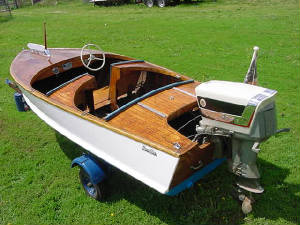
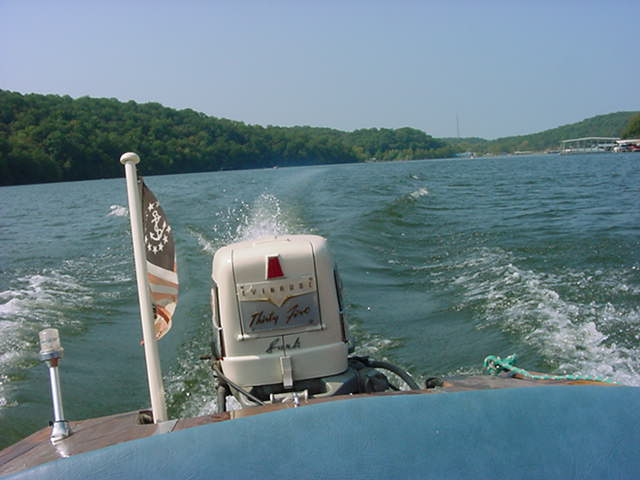
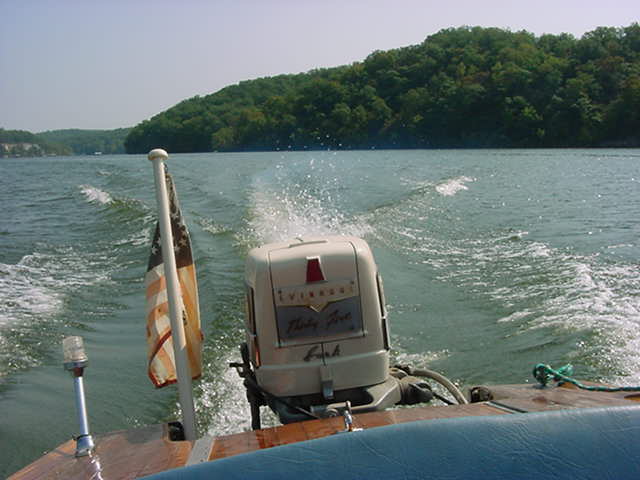
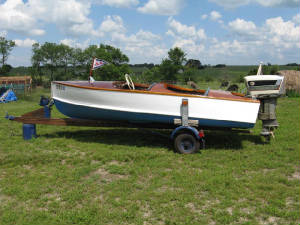
Left side rear. Thats a 1958 35 Horse Evinrude on the stern. It appears to be the original engine on this boat
and it was gone over in 1992 with a rebuilt lower unit. The cowl on my engine is cast aluminum and the fittings on
the shifter appear to be in their original spots. Both the boat and motor were originally bought from "Doc" Chauvin and a
brass plaque is fixed to the side of the engine which says :
"Doc" Chauvin
Boats, Motors,Trailers, Chain saws
60
- 75 + 275 Lake Av
Worcester Mass
Model SN
Like on the boat, the plaque does not
have a model or serial number on it. The engine itself has a plate that gives the serial number as 35514 - 03795 .
The 35514 is the model number and designates the engine as a 1958 year engine. The front of the engine cowl says Evinrude
Thirty Five Lark and on the back there are the numbers 35.
The boat is a "Q" deck series which has the center pass through deck and rear deck. The Captivator Penn Yan standard
boat has a designation of "KTF" which is the first of the series of numbers on the center rear knee. The next two numbers
designate the year. The number stamped on the center rear knee of my boat is "KTF 54375", so she is a 1954 Captivator, Standard
version, and the 375th one of the type built. She is painted in the original colors of the Standard series with white sides
and blue bottom.
|
 |
The right side was rebuilt in 1985 with fourteen new oak frames steamed in. Clear cedar is difficult to find
so I used basswood double hull with plastic between the layers as was used in the original. I used bronze boat nails like
original and soaked the inside a bunch of times with Cuprinol preservative. The repair work looks good, is hard to distinguish
from the original and is structurally sound. The boat looks and runs well.
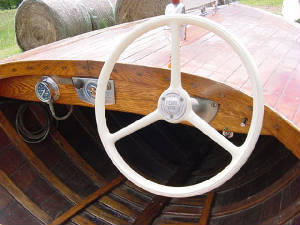
The aqua meter speedometer is original and looks good but it is not operational. I use GPS to register speed these days.
The seats were re-done in 2005 to the correct color for the model year the boat was built.
|
|
There is a brass plaque on the right side of the transom:
Penn Yan
All wood plactic core
Striptite
hull construction
Patented
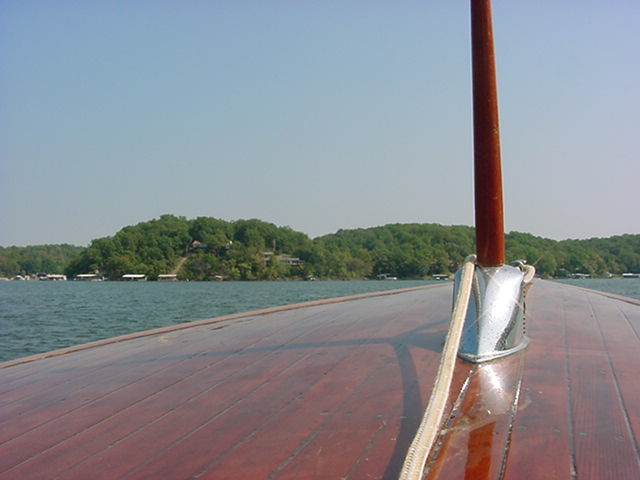
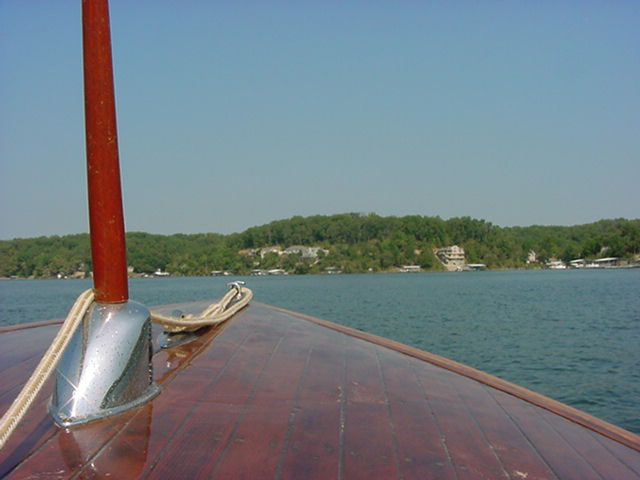
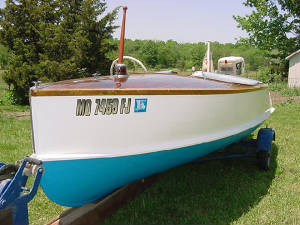 Here is a picture of the bow. Instead of having numbers and registration painted on the side, I wanted a removable plackard
board above the deck, which is what you see on the other pictures. However, the registration folks wanted the numbers on the
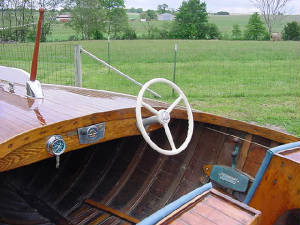
bow itself, so here is the new registered look. There was originally a windshield, long since gone. There are indications
in the deck that it was there, but she looks better without one so I am not interested in putting one back on. I also like
the wind in my face, as well as the unobstructed view. She looks lower and sleeker without the windshield as well. The trailer
is a combination of the original steel and a new central frame of wood. It makes for a nice classic look to the boat/trailer
combination. There are no brakes but on this light set up, they are not really needed. Trailer lights were put on a couple
of years ago and are not shown on these photos.
Paint can hide all kinds of woes on an old wooden boat, so it is always with a bit of trepidation
that one removes large amounts of it, particularly on the bottom. It was nice to find that after paint removal, the hull is
still in very good condition with no rot visible. I have learned a few things about the boats history and building while removing
paint. It appears that the whole boat was originally painted white, with a coat of light blue below the splash rail. The subsequent
bottom paint layer colors were light green, black, dark green, bright red, brown, reddish brown and
light blue. Planking looks good for its age. On each side of the keel the outer layer of planking is made up of three 3 5/8”
wide planks, and then about twenty 1 1/16” cedar planks running up to the gunnel. There is an additional keelson added
by me for strength when I replaced bad cedar planks with basswood ones on the starboard side in the
mid 1980s. The repair still looks good and the wood is tight. There are some slight curves in the bottom, but this is understandable in a fifty year old boat. The keel, keelsons and splash rails are oak, and the fittings
are bronze. I took her out a few times on Lake of the Ozarks a few times before I sold her to a fellow in North Carolina.......
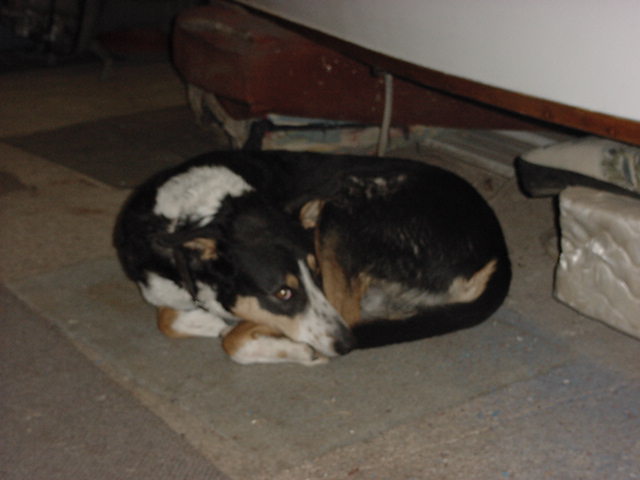
Duffy is always ready to help with the big jobs. But, he is not all that keen on heading out on the lake.... Guess I
will have to go by myself.....
|
|
There is a brass plaque on the dash which reads:
"Doc" Chauvin
63-75 & 275 Lake Ave
Worster,
Mass
Mod ______ Ser_____
There are no numbers in the boxes. They were either never put in or they were so
light that you can't see them anymore.
Apart from the overhaul of the right side, I have only been working on the boat a little bit here and there as time allowed.
But recently I have made a point of trying to get her finished. She is now up to speed and looking good although she will
never be a show boat. She is a good example of a working Penn Yan that is out having fun without museum quality hoopla. That
being said, I have had her for over twenty three years, and she has always been inside while I have owned her. So she
is somewhat pampered.
After the last cruise on Lake of the Ozarks, the pounding opened up a number of seams causing leakage. I have been trying
to refrain from the Epoxy option for repair, but I think that the time has come to strengthen the hull. The picture is of
the upside down boat so I can work on the bottom.
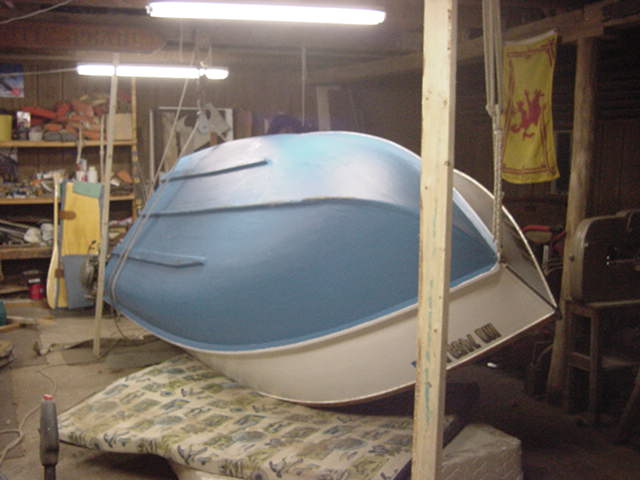
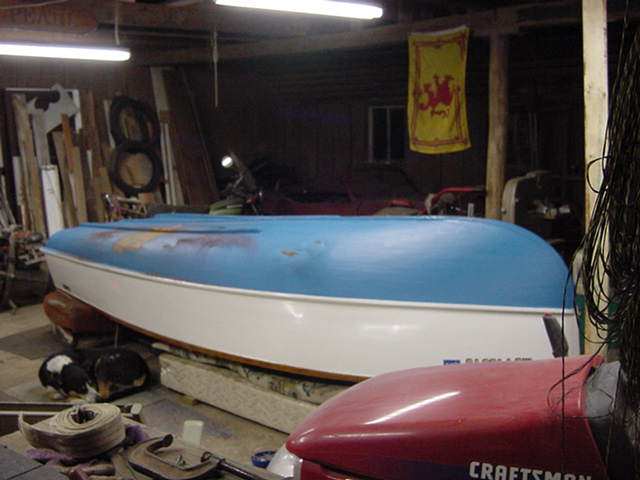
I spent one summer removing the layers of paint and found the hull in very good shape. I used Interlux epoxy
on the bottom up to and including the lower edge of the splash rail. Two layers on the bottom, three on the keel and
skegs and one layer up to the splash rail. Here we are starting the flip over after the epoxy work. The paint color
is as close as I can get to the factory original. The upper side of the splash rail and above the splash rail is still painted
wood. I did purchase a Penn Yan Pennant for the bow staff from the Penn Yan site, but it is printed the same
on both sides so that from one side the writing is backwards. Note the two extra keelsons on each side of the keel that were
installed back in the 1980s. These strengthen the hull and help protect the bottom in the water and on the trailer.
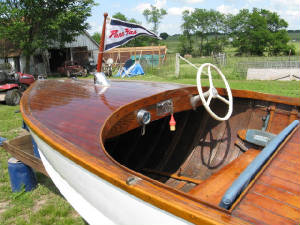
The e-poxy job is done with two coats of resin and cloth on the bottom and three on the skegs and keel. I ran the e-poxy
only up to the outer lower edge of the splash rail and to the water line on the transom. This would strengthen and protect
the wood, yet keep the wood visible in all the upper areas. You have to look really hard to notice that there is an e-poxy
coating on the bottom, and with the bottom paint in place the boat looks identical to the pre-epoxy condition. But now she
is much more user friendly and of course there is no leakage problem. She is much safer now in a chop because no seams are
likely to open up and she still holds her original image.
|